Thursday, 12 August 2010

A volunteer's remuneration

"You're going to work for a year and not get paid for it?" asked my Grandma before I left for India, surprised that anyone would contemplate such a thing. Police officials, when interrogating you to decide whether they should extend your visa ask the same question "And you receive no salary?" "Yes", say I, the innocent do-gooder stupid enough to work for free.

You see, for me, my short professional life has never been about the money. It has been about making a difference, working for organisations I believed in, doing a job I enjoyed. I've always been happy to volunteer in the evenings and on the weekends.

No one becomes a VSO volunteer to get rich. VSO pay most of your expenses, give you an allowance and sort out your accommodation up to certain budget, but the idea is you don't make money from your VSO placement, but neither do you lose money. In reality, if you want to go on holidays or weekends away, you've got to use your savings. My allowance is 10,000 rupees a month, or £140, but compared to Indian colleagues that's a fair wage, and ours doesn't have to be spent on accommodation and supporting a family. We're lucky really.

So, our remuneration doesn't arrive in our bank accounts at the end of each month. It's etched on our memories, engrained in our future lives. Experiences so alien to life back home that they will shape our thinking for years to come. I've gained a whole new family- parents, uncles, aunties, brothers, sisters and cousins who have taken me in as one of their own and taught me how to live as a Rajput young lady. After just 4.5 months at my NGO I've got more confidence professionally and have learnt about so many development issues and how they affect local people- climate change, child marriage, sanitation, child labour, conservation. Personally I've grown stronger and more sure of myself and I'm left with a sense of satisfaction that I am using my efforts, no matter how small, to help.

Last Sunday after a staff function I was left feeling honoured that I could serve the rural communities in Rajasthan. I'd completed some work for GVNML- a new logo, a slogan (Nurturing sustainable rural change), the launch of our new website, which I wrote, and the printing of our latest annual report, and we were celebrating. The aim of the communications work is to increase GVNML's visibility so that we can spread their initiatives to other needy areas and generate more funding.
I wasn't sure what to expect at the 'logo party', and when I arrived there were 40 members of full time staff from 3 districts sitting opposite a cloth covered board. After senior staff explained the background of the logo change, six of us were invited to stand by the board and together took away the cloth, revealing the logo decorated with flowers. The annual report was wrapped up like a present and unwrapped one of the NGO founders while everyone clapped. I was invited to light a candle to celebrate. I only caught the odd word of the speeches that followed, but there was a lot of dhanyavads, or thank yous to Isabel, combined with clapping. My own unplanned speech didn't come out quite as expected, just a simple few words saying how pleased I was to be here and able to be of service. Work often progresses slowly in India, which makes it even more satisfying when it does get finished. And that warm fuzzy feeling, that's my remuneration.

Photo: GVNML staff by their new logo; the finished masterpiece; me lighting the candle in traditional Rajasthani dress.

Wednesday, 4 August 2010

What 210mm of rain looks like

21 cms and a few weeks is all it's taken to transform Laporiya's semi-arid landscape from a dusty desert into lush fields filled with crops. Villagers are smiling again safe in the knowledge that their family's future is secured for another yearas and their buffalo enjoy midday swims in the talab.

My 13 year old brother Pratab has never seen rain this heavy in July, anecodotely it's the best rainfall Eastern Rajasthan has seen for over 10 years. The 2009 monsoon only brought a crippling 200mm to Laporiya, well below the average of 614mm. This year we've exceeded last year's total and still have a good few weeks to go before the rains slow.

The first thing I do when I get into the office in the morning is pour the previous day's rainfall into a measuring contraption and record the amount. With funding from the Swedish Society of Nature Conservation, GVNML have been able to purchase a whole host of weather recording equipment so by next year we'll be recording changes in temperature, humidity, rainfall and wind velocity. The data will be used to guide programme activities so that farmers can better cope with climate change and protect their livelihoods.

Before the rain came...
From top: Government built farm pond on our farm; one of my Indian family's fields; the holy lake of Pushkar, 2 hours away.)

And after...

Sunday, 25 July 2010

Testing times in Varanasi

It's no secret that at times I find my placement a struggle but one of the things that helps me through it is the community of VSO India volunteers always there to offer an ear to listen to your latest problems and the distraction of days spent together. Another UK volunteer, Debs, and I had planned a trip to Varanasi, in Uttar Pradesh, two months ago and were both looking forward to the chance to catch up, having last seen each other 3 and a half months before.

My 18 hour train from Jaipur to Varanasi was fully booked for the day we were supposed to meet, so I left Jaipur a day early and spent the first day on my own in one of the oldest cities in the world. The problem was Debs never arrived; in fact she never left Kolkata. Her train was cancelled and I was faced with a weekend alone at a time when I most needed the company.

But these times are sent to test us. So after some moping and considering trying to change my train to an earlier day, I became determined to enjoy myself. It wasn't just that I was alone, it was the expectation I'd built up of a comforting weekend. Luckily the guesthouse we'd picked was well geared up for travellers, so I booked myself on every tour going. A dawn boat ride along the ghats, a sunset boat ride and a walking tour of the old city. In fact, after a couple of days I actually started to enjoy myself. I got into the swing of chatting to other travellers and spent one day with a couple of Canadian friends. By the end I felt immensely proud of myself that I'd survived the experience, I felt stronger and more aware of my own ability to cope.

Now Varanasi isn't perhaps the best place to go travelling on your own. Lonely Planet describe it as one of the most overwhelming places in India filled to the brim with touts, locals trying to drug you with contaminated chai, gangsters, food poisoning, burning bodies and dirty narrow airless streets.

Perhaps it's because I've become used to India and how to handle the opportunistic locals attempting to take advantage of tourists, but I found the city strangely relaxing. Yes, there were touts waiting for me when I left my guesthouse but they were harmless. It was dirty and humid, and the power supply was terrible so little relief from fans, there was lots of undoubtedly dodgy street food but I didn't touch it, choosing instead to eat almost all my meals in a German bakery who put all their profits into a kid's school and a women’s upliftment charity.
Looking out onto the Ganges, lined with Hindu temples from my guesthouse balcony filled me with calm, my eyes resting on the wide open space the river and its dry bank filled. 60,000 Hindus visit the ghats along the Ganges each day to take a dip, believing that the holy waters will wash away their sins. Dying in Varanasi, or being cremated here offers instant liberation from the cycle of birth and death and 300 bodies a day are cremated in two burning ghats. It was humbling to observe the process, to know that although this was a sad moment, these families believed they were guaranteeing everlasting life for the deceased. Some members of society aren't burnt; the bodies of babies, pregnant women and sadhus (holy men) are lowered into the water attached by ropes to a stone and left to sink to the bottom, often rising to the surface a few days later as the ropes disintegrate, nibbled by fish. At dawn I saw a distressed father dropping a baby shaped parcel into the river. A life over before it had even begun.

Simultaneously religious ceremonies hundreds of years old stay alive in constant performances along the waters' edge. The daily evening aarti ceremony, performed by Brahmin (priest) students, offers prayers to Shiva, the Ganges and the obligatory request for World Peace. I offered my own pujas over the weekend, praying for strength and as I saw my candle burning brighter than all the rest as it floated away, I felt my request had been granted.
Photos, from top to bottom: Dawn boat trip; view from my guesthouse balcony; piles of wood for sale at the burning ghat; Varanasi preparing for the evening aarti ceremony.

Saturday, 24 July 2010

The full force of the monsoon

Today the monsoon hit, hard. 54MM of rain fell in Laporiya in a couple of hours. As my Indian father sweetly joked, it was also monsoon in my bedroom. Even though the mason came a couple of weeks ago to fix the holes on the flat roof above my room and fitted a blue plastic sheet, the rain found it's way in. When I opened the door after my shower I found cascades of rainwater pouring in through the crack where the ceiling joins the wall above my desk. Everything on my desk was soaked, which included a notebook full of personal thoughts that's very dear to me, my Norton Anthology of Poetry, my laptop, the paperwork I need to give to the police to get my visa extension, all the photographs on my wall and plenty of other bits and pieces. It was pretty devastating especially as I'd been feeling low anyway. I've cleared up the worst of it now and am ready to renounce all my worldy possessions so that I don't feel the sense of loss again after another natural disaster.

For the rest of the family and for the staff at GVNML, and for all the villagers, it was a good day. Enough water fell to fill the ponds and irrigation systems that GVNML spends all year building. In fact this has been the best monsoon for a few years, but it's still not enough to cure years of drought.
Mama celebrated by making pakora, and Laxman Singh, my father and founder of the NGO gave me a bottle of 'spicy wine'. It turned out to be whiskey, made in Rajasthan. So after not drinking for 6 weeks I'll raise my glass to the monsoon.

Photos from top to bottom: the offending crack; the damage done; the village talab outside our house almost full; celebratory pakora; Rajasthani whiskey.

Wednesday, 14 July 2010

My new canine friend

Not long ago, while I was staying in Jaipur I heard that we had a new dog and her puppy in Laporiya. After a previously unsuccessful attempt to convince my boss that a new puppy was just what we needed, I was surprised at this new development, but elated.

When I first met Solanka and her unnamed 5 day old daughter they were tied up near where the tractors are kept looking scared and intimidated. The next morning I went searching for the puppy only to impale a spike from a tractor accessory into my little toe causing enough blood loss for me to be worried, and my first public tears in front of my Indian family. My boss came to the rescue and patched me up using a combination of whiskey, TCP and my VSO first aid kit. I tracked down the puppy soon after, only for it to be taken away the following day to live at our training centre 11 kms away.

So we're left with the lovely Solanka. She's been living here a week or so and is no longer tied up and has moved into the main courtyard where most of the family interaction takes place. I've taught her how to play fetch and have been making sure she's got enough water. What marks her out is her sweet natured character, so different to the other dogs in the house who become hardened and fend for themselves apart from being given roti and milk twice a day. Although our three dogs may be pets, come to India with the pet dog mentality of England and you'd be in trouble. It's only recently I've learnt exactly what the perimeters are- no petting dogs, dogs are not allowed inside any rooms, dogs are not walked, do not touch the dog bowl, instead take roti to the dog bowl and drop inside, if you have to touch the dog wash your hands straight away with soap, dogs are not allowed near the washing up area. Any dogs disobeying these rules are shouted at and even hit with a stick (Grandma is chief discipliner). With Solanka I try to ride the middle ground, petting her but always washing my hands in full view of the family.

In India stray dogs roam the streets of every city, town and village. Human inhabitation attracts them, but people do keep pet dogs here. In Delhi particularly, take a walk in any park and you'll see well fed pet dogs wearing collars being walked, often Western breeds like retrievers and labradors. When I go for a run in Laporiya, which I'm ashamed to say I seldom do nowadays, I keep an eye on where the nearest sticks are, just in case a rabid dog approaches me. They are so used to being hit by villagers that if you even raise a stick they run. There have been no known recoveries from rabies, so if you're bitten you have to get to the hospital pronto. My Indian cousin was walking through the village to a wedding one evening and stepped on a sleeping dog by mistake. It proceeded to bite him and he was taken to the nearest hospital in the morning.

The oldest of our pet dogs is a boy called Sheru, which means lion in Hindi. Coincidently that's also the name of the older dog at our training centre. In fact in turns out Sheru in a very popular dog's name in India, which led me to ask the question, "But what happens if you lose your dog and everyone else is calling Sheru too". It didn't seem to be a problem in India.

So back to Solanka, who greets me every morning by raising her paw, tries to follow me into the office and supervises while I practice yoga on the roof. At lunchtime while I'm having my nap she'll lie next to my day bed. In her I've found a new friend and a consolation for not having my own jack russell Dotty here.

Sunday, 11 July 2010

Hindu Wedding Number 2

My family were invited to a wedding last weekend and so it came to pass that I attended my second Hindu wedding. It was held at a wedding garden in Jaipur and celebrated the matrimony of the daughter of a GVNML consultant. A wedding garden is just that, a well-tended garden hired for a night by families whose houses aren't big enough to host the grand celebrations their culture requires. The party was a lavish affair, hundreds of guests wearing sparkling saris, turbans in vivid colours, heavy artificial gold and diamond jewellery, and more refreshments and delicious things to eat than you could ever want. For me, the food was the best bit. There were all the best street snacks and home-cooked food in Rajasthan in one place, at no cost, and you knew it would be delicious and safe to eat. I ate kachori, kulfi ice creams, street style food with names I don't know and delicious accompaniments, orange sherbet cold drinks, a mango, melon, banana and grape medley from the fruit stall shaped like an arcade game. Then there was the proper buffet, with different vegetable curries, various types of freshly made breads, rice, lots of sauces and delicious sweets. My desire to try everything left me feeling a little sick by the end of the evening and every time I turned round my 7 year old cousin had another ice cream in her hand.There was also a paan stall, a practice which goes back 3500 years in India, used as a breath freshener, to aid digestion and as a relaxant. I've tried paan before a few years ago in Mumbai, and remember finding it disgusting, but seeing the eagerness with which guests tucked in to the beautifully made betel leaves stuffed with areca nuts, spices and sweet fruits, I decided to have another go. I chewed on half a leaf wrap for a few minutes, then had to spit it out. I can see why people like it, I felt wired for a good hour and yabbered away on skype to England when I got home.I'm still getting my head round the Indian wedding ceremony. At this party I saw the groom being danced onto the stage, surrounded by male family members showcasing their bollywood moves, and sat waiting on his wedding throne. He was made to wait a few minutes for the bride, who then began her entrance under a blanket held above her head, with a drum leading the procession. When she finally arrived on stage she had to place a flower garland around the groom's neck. Comically, he got his friends to lift him up on their shoulders so that she had trouble reaching, but making a run for it, she managed to throw the garland over him to much cheering. Apparently the bride could have spent up to 6 hours in the beauty parlour getting dressed and applying layers of makeup and all her jewellery. Her dress weighed so much she had to slowly shuffle through the crowds of guests.
From what I understand, the bride and groom are given a holy time, declared by the Brahmin (priest) as the most auspicious for them to perform the coming together as man and wife. After this, the Brahmin prays with the new couple for 3-4 hours. My sister Ratan's holy time is 4am, so a long day for her. For more details all the different traditions that make up a Hindu wedding, wikipedia has a good entry.
As I was given an hour's notice that we were going to this party, I didn't have my traditional clothes with me so made do with a new kurta. For Ratan's wedding I'm going shopping to choose my dress next week, 4 months in advance so that I'm all ready. The wedding will be very different to this one because of my family's caste. In Rajput weddings the groom is the only man inside the house, all other men party outside in the grounds while the women have the courtyards inside. I think they might make an exception for my Dad so that he's not on his own outside while I'm with my Mum and sister in the house. At Rajput parties, meat and alcohol also make a special appearance, two luxuries I rarely have.

Saturday, 3 July 2010

The problem with water


I have a faint memory of living in a country where I turned the tap on and water came out, where I had baths, used washing machines and we complained about the regular rain.

For the last few days I've been living in Jaipur, where the availability of water is very different. In my family's house there, water only comes out of the taps from 5am until 6.45am. Most of the household wake up for 5, armed with buckets and water pots. Two doors down is GVNML's accounts office, so a long hose is used to link the office tap to the water storage tanks in the family home. Next door is a small temple and this tap is also used for filling the buckets of various residents of the street.
There are on average 10 people living in the Jaipur family home at any one time, usually a combination of children attending school in Jaipur, and mothers or fathers looking after them or in the city for business meetings. It's estimated that it takes 1,000 litres of water to run the house, for washing bodies, clothes and kitchen pots, for cooking and for drinking, and most importantly, for using in the coolers that make the soaring temperatures bearable. Even with the extra supply of water from the office and the temple, what comes through the tap usually isn't enough.

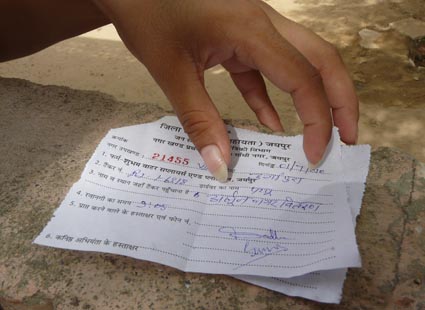
Three months ago the taps ran for two hours each morning and evening, but since the water cuts a government water aid tanker has been coming to this street every afternoon. At around 3pm the children stand ready to refill their buckets then sign the government slip as evidence the tanker has stopped at their house.

There are areas of Jaipur worse hit than ours. The Times of India recently reported that certain parts of the city are having their daily water supply cut by 10 minutes. "The measures were taken to tide over the crisis facing the city and stretch the resources considering the delay of the monsoon in the state." 100 protesters mobbed the Public Health Engineering Department (PHED), fighting against the erratic water supply and demanding more tankers. One protester said, "We have not been getting a proper water supply for the last 15 days and when we ask for water tankers the officials are evasive. They do not listen to us."

The problem is that Jaipur has no water supply of its own. Water comes from the Bisalpur Dam which was originally large enough to supply eight districts in Rajasthan, but now it's drying up fast. My sister told me that in 2 weeks the dam will be empty. Again, the Times of India reported "Expected to give 400 MLD (millions of litre per day) of water, the government is now fighting tooth and nail to draw even 20 MLD per day". PHED officials said, "At best it is only for 10 days more that we can supply water from here. After that Jaipur will have to be totally dependent on ground water and this project will have to wait for the rain god's mercy."

After years of exploiting groundwater in Jaipur, there isn't much left to draw from wells or bore holes. Last Tuesday The Hindu newspaper announced a 40 crore (£5.6m) emergency plan led by The Government of Rajasthan's Water Resources Department to supply water to Jaipur and Ajmer districts until the end of July in an attempt to maintain normal levels of water supply. Senior officials and engineers said, "The delay in monsoon rains had made the water supply situation very critical in the State, which was already grappling with paucity of water." Drinking water will be brought on trains from Kota, in Western Rajasthan.

As the BBC weather forecast promises daily rain, we are still waiting for the downpours that will save this city from dehydration. I am lucky, on Sunday I will return to Laporiya where we've got our own well, with enough water it in to not worry about washing twice a day, and scrubbing clothes clean.